Chapter 1: Introduction
1. Three Aspects to study Database
- 1.Modeling and design of databases.
- Get (abstract) data models from real world, then translate them into the forms suitable for the target DBMS (Database Management System) - tables, views.
- 2.Programming: use database
- queries and update of data.
- 3.DBMS implementation
- how does DBMS work, and how to design a DBMS.
两种访问数据库的方法
- 方法1:利用数据库管理系统提供的交互工具访问数据库
- 方法2:利用开发工具设计界面、处理数据,调用ODBC访问数据库,如ASP,JSP,VC++,PHP,PowerBuilder,Delphi
2. The definition of database
Database:
- A collection of interrelated data, relevant to an enterprise.
- A large collection of integrated and persistent data (DB). [R. Ramakrishnan, J. Gehrhe]
- A collection of information that exists over a long period of time, often many years. [Ullman]
- 长期存储在计算机内、有组织的、可共享的数据集合。[萨师煊,王珊]
Database Management System (DBMS ):
( Database ) + A set of programs used to access, update and manage the data in database.
Major properties of DBMS
- Efficiency and scalability (可扩展性) in data access; Reduced application development time;
- Data independence (physical data independence / logical data independence);
- Data integrity (完整性) and security;
- Concurrent access and robustness (recovery).
3. DBMS
evolution
- File processing system (1950s-1960s)
- Network and hierarchical DBMS (1960s-1970s)
- 网状数据模型、层次数据模型 - 网状数据库、层次数据库 (结构复杂、使用很困难)
- Relational database systems (RDBMS)
- Relational model (1970, E.F. Codd)
- Relational database system developed (late 1970s)
- Relational database systems on the market (1980s)
- Matured relational DBMS technology (1990s)
classification
- Object-oriented database system (OODBMS)
- Object-relational database systems (ORDBMS)
- Application-oriented database systems
- Spatial, temporal, multimedia, Web databases
- Data Warehousing (数据仓库), Online Analytical Processing (联机分析处理), and Data Mining (数据挖掘) systems (for data analysis)
4. Levels of Data Abstraction
different levels
How to use DB - Different usage needs different level of abstraction. (e.g., student score management system)
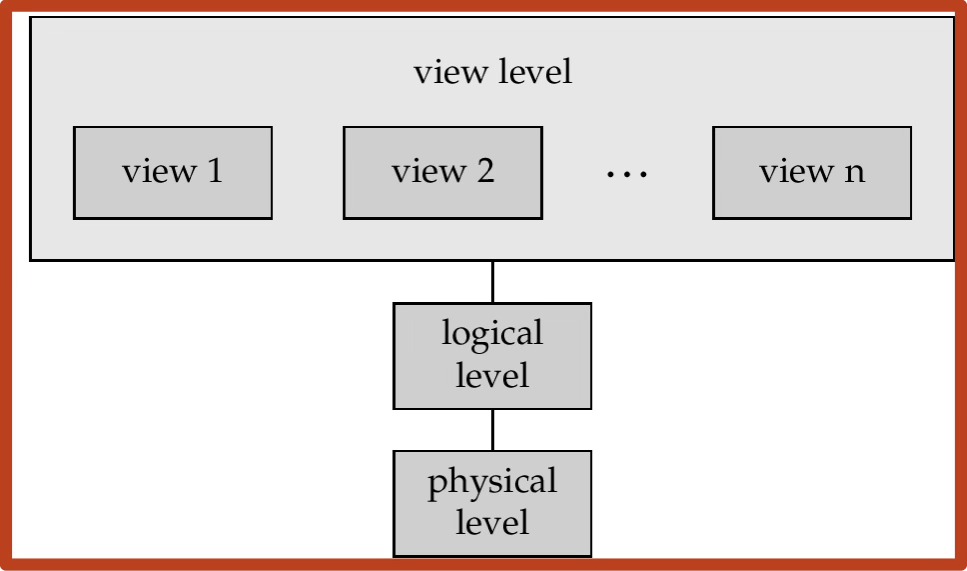
- Physical level: describes how a record is stored. Files
- Logical level: describes data stored in database, and the relationships among the data on upper level.
- View level: application programs hide details of data types. Views can also hide information (e.g., employee’s salary) for security purposes.
Schemas (模式) and Instances (实例)
- Similar to types and variables in programming languages ( type ↔ schema, variable ↔ instance)
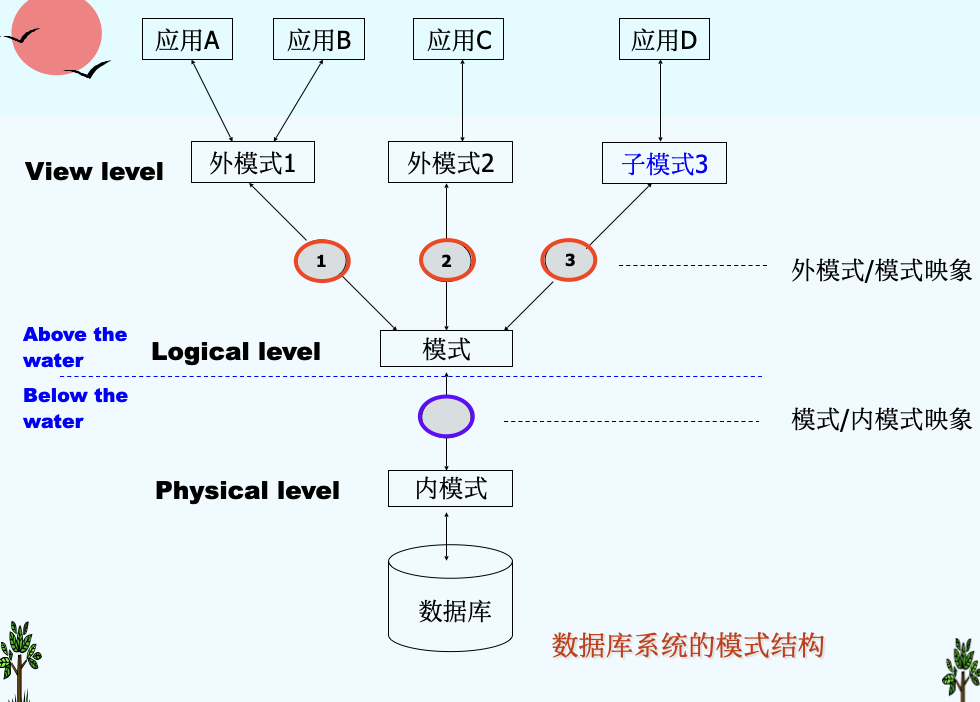
- Schema - the structure of the database on different level
- Analogous to type information of a variable in a program
- Physical schema: database design of structure at the physical level
- Logical schema: database design of structure at the logical level
- Subschema: schema at view level
- Instance - the actual content of the database at a particular point in time
- Analogous to the value of a variable
5. Data Models
- Data model is a collection of conceptual tools for describing:
- data structure
- data relationships
- data semantics
- data constraints
- Different data models:
- Entity-Relationship model
- Relational model
- Other models
Steps of Database Design
- Requirement analysis
- What data, applications, and operations needed
- Conceptual database design
- A high-level description of data, constraints using E - R model or a similar high level data model
- Logical database design:
- Convert the conceptual design into a DB schema
- Schema refinement
- Normalization of relations: Check relational schema for redundancies and related anomalies.
- Physical database design : Indexing, clustering and database tuning
- Create and initialize the database & Security design Load initial data, testing Identify different user groups and their roles
Entity Relationship Model (实体-联系模型)
The diagram is below: 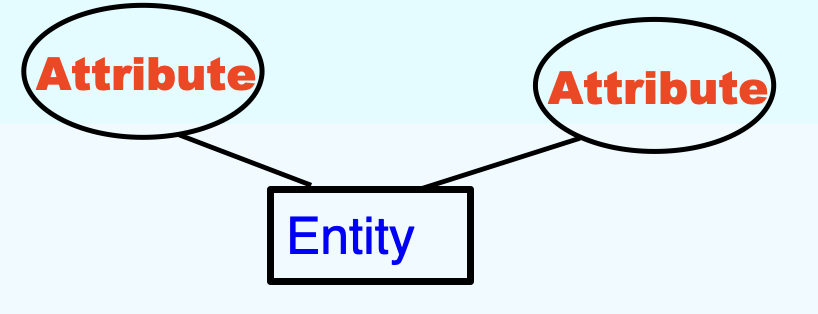
Let's show an example: 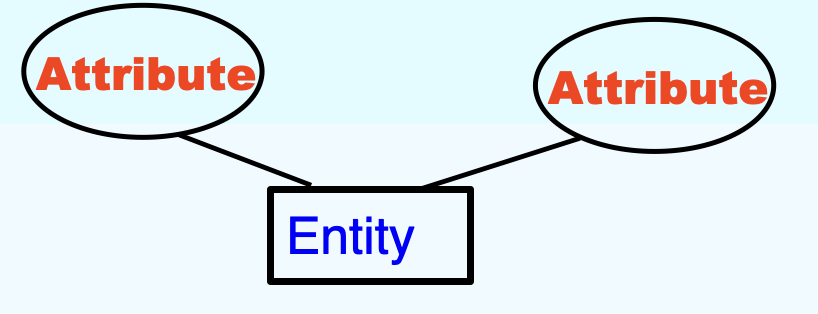
Relational Model
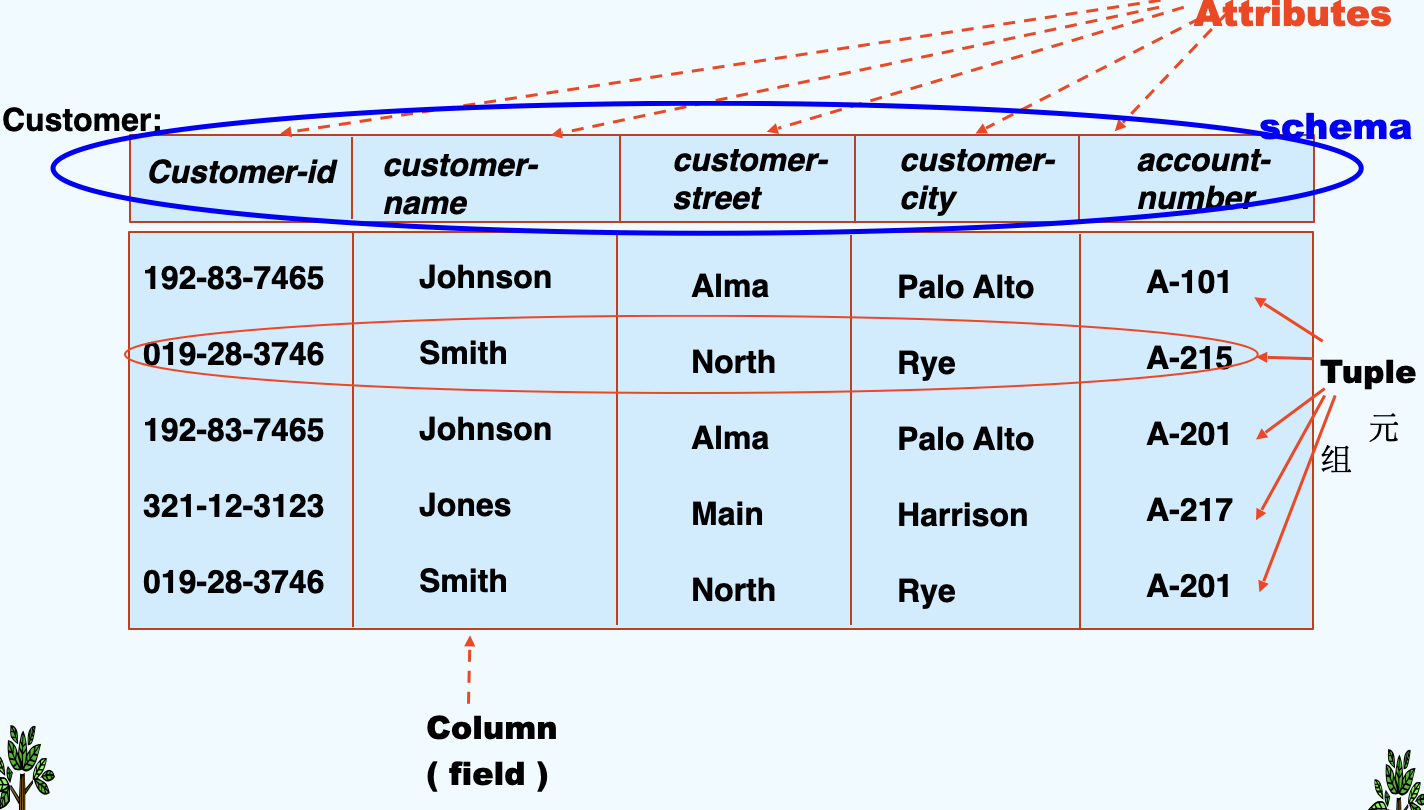
From the diagram we can understand the meaning of schema, attribute, column and tuple.
6. Database language
Database Language:
- Data Definition Language (DDL, 数据定义语言)
- Data Manipulation Language (DML, 数据操纵语言)
- Data Control Language (DCL, 数据控制语言)